Nathan Deal Judicial Center
Georgia Building Authority (GBA) & Georgia State Financing and Investment Commission (GSFIC)
Projects > Nathan Deal Judicial Center
Georgia Building Authority (GBA) & Georgia State Financing and Investment Commission (GSFIC)
Design Award:
Precast / Prestressed Concrete Institute | Design Awards: Government and Public Honorable Mention | 2021
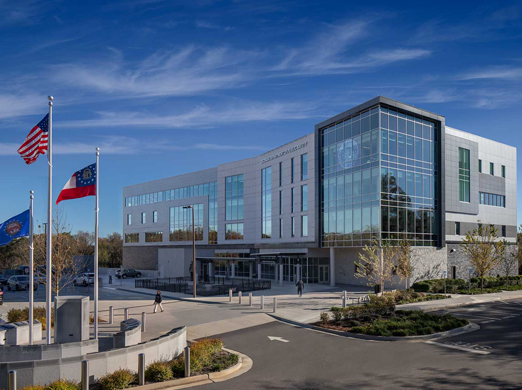
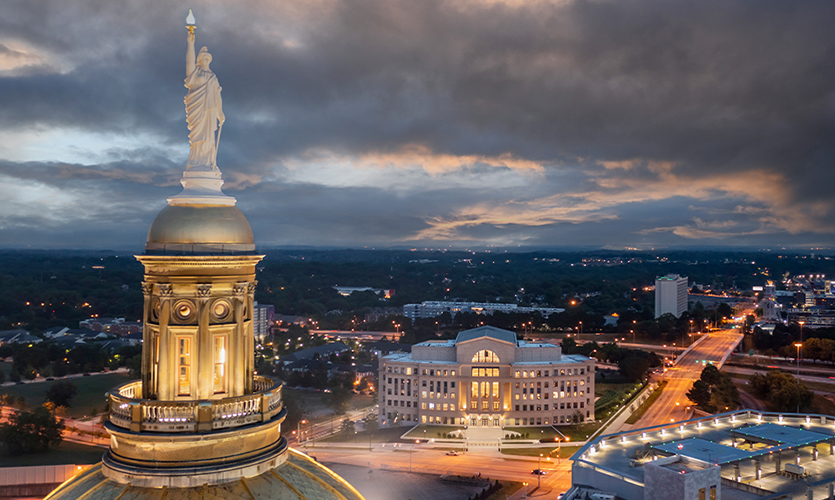
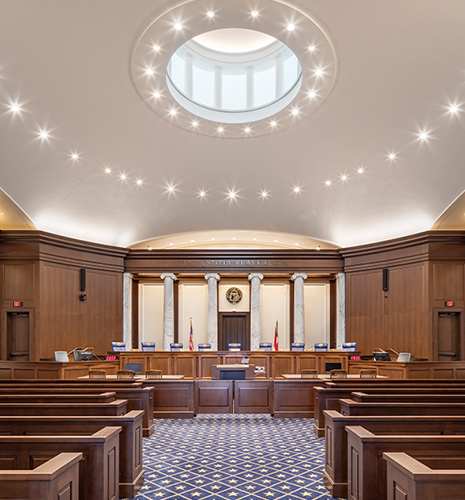
The Nathan Deal Judicial Center is the State of Georgia’s first building dedicated entirely to the Judicial Branch. The seven‑story, 224,500 SF facility brings the Supreme Court of Georgia, the Court of Appeals, and the statewide Business Court together in a purpose‑built environment designed to support efficient operations, long‑term growth, and public accessibility.
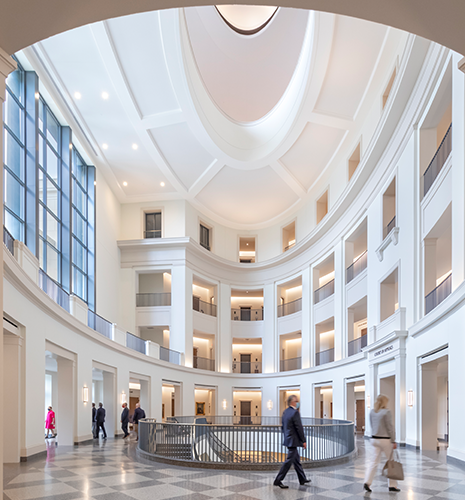
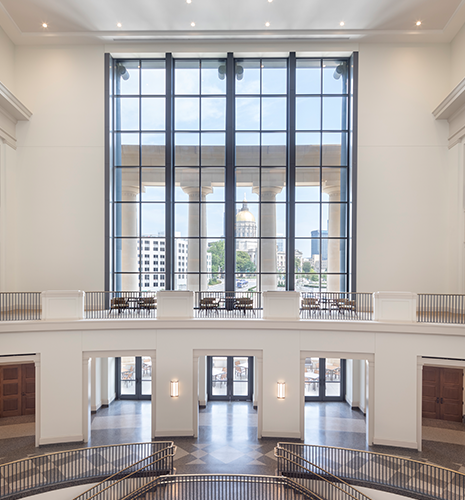
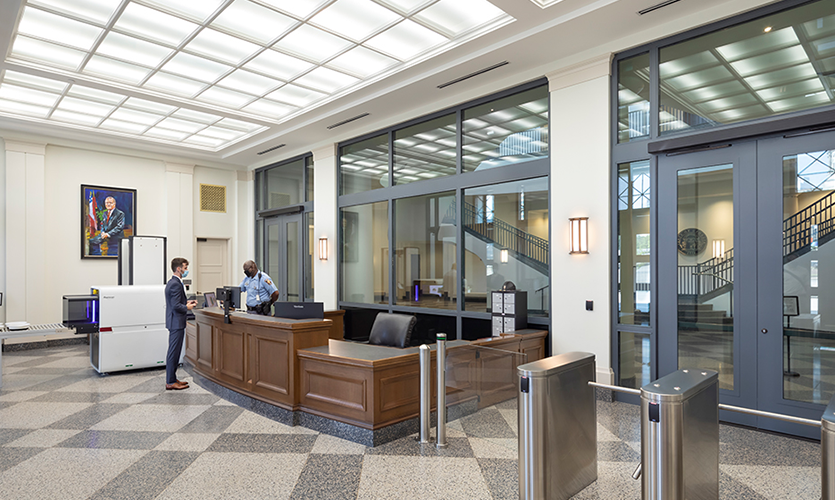
SSOE served as Architect of Record, partnering with Robert A.M. Stern Architects (RAMSA). From the earliest planning stages through construction, our team worked closely with the Courts, GSFIC, Georgia Building Authority, and State Properties Office to ensure the facility met operational needs, respected the Capitol Hill district, and demonstrated responsible stewardship of state resources. The building’s placement, orientation, and façade were carefully planned to enhance the Capitol complex and present a recognizable, civic‑minded presence to the public. A 112‑foot central atrium brings daylight deep into the building, simplifies wayfinding, and creates a safe, clear connection between judicial functions and the public.
State leaders entrusted SSOE to guide this project across more than a decade of development—from programming and site selection through design and construction. That responsibility included the demolition of the former State Archives building, navigating a highly constrained site, and coordinating multiple agencies and oversight bodies. Throughout the process, our team focused on transparency, communication, and predictable project delivery to ensure the building opened on time and within budget.
The Judicial Center incorporates energy‑efficient HVAC systems, LED lighting, water‑saving fixtures, and Georgia‑sourced materials to reduce operational costs and support the state’s sustainability goals. Furniture and courtroom components were reused and refurbished where possible, extending the life of valuable assets and reducing waste. The project achieved a three‑Peach rating under the Georgia Peach Green Building Rating System—one of the few buildings in the state to reach this level.
“This is a magnificent architectural achievement that should evoke pride in the entire state … it embodies the ideals of our courts, as well as Governor [Nathan] Deal’s deeply personal commitment to criminal justice reform and to this great state.”
— Associate Justice Clarence Thomas, U.S. Supreme Court, at the Dedication Ceremony


 Dorchester County Courthouse
Autodesk Construction Cloud (ACC) is SSOE’s enterprise-wide project delivery platform. We partner with the Autodesk Product team and have research access. Use of the AI Assistant allows our design teams, owners, and general contractors the ability to query the project specifications for quality, answers, and more rapid responses to RFIs, submittals, or issues.
SSOE has developed a proof-of-concept to use an AI Agent to act as a Master Engineer and Architect trained in SSOE’s processes, best-known-methods, and trainings. Our data structure is being remodeled to enable better use of our proprietary knowledge to train the agent on the ‘SSOE way’.
SSOE is actively piloting AI Chat large language models (LLMs) or copilots that use Natural Language Processing (NLP) to streamline both design and development tasks, transforming how our teams interact with software and each other.
By integrating chat LLM engines into platforms like Revit, we’re enabling users to prompt complex actions using simple, conversational commands. In Revit, this means automating tasks such as modeling elements, cleaning up parameter data, managing annotations and dimensions, and organizing sheets—without writing scripts. These automations and quality prompts can be shared across project teams, accelerating workflows and reducing manual effort.
Similarly, our internal Software Development Community is leveraging GitHub Copilot to expedite coding tasks. Developers can generate and refine code using NLP prompts, tapping into GitHub’s extensive Repo to move faster from concept to implementation.
Together, these tools represent a shift from traditional, expert-driven scripting to intuitive, AI-assisted automation, unlocking new levels of efficiency and scalability across our projects.
We helped our client visualize and optimize façade design for occupant comfort—long before breaking ground through the use of the Autodesk Forma tool. It allows the designer to rapidly experiment with the building’s geometry and façade design to promote sustainability, prioritizing quality of spaces and comfort for end uses, especially in extreme climates (daylighting and microclimate analysis tools) at the project’s exact geographic location, using location-specific environmental data.
Discover how SSOE is using Autodesk Forma to improve sustainability outcomes for industrial projects: SSOE Group: Improving sustainability outcomes for industrial projects with Autodesk Forma.
SSOE is utilizing Microsoft Copilot Edge and M365 to significantly enhance work efficiency and accuracy across various departments. Copilot is accessible to all staff after training. Key areas of application include using it as a writing assistant, for idea generation, document summarization and generation, research assistant, excel assistant, programming code assistant, language translations, product comparison and data analysis. Use of Copilot has become part of the everyday life of SSOE employees who have identified key ways it can help them become more efficient with their daily tasks as well as more accurate in their deliverables.
Today, 100% of SSOE employees have taken the voluntary training and have access to Copilot Edge, achieving early our October 1, 2025 goal.
We found ourselves in need of a more robust tool to enhance resource forecasting and staff assignment capabilities. Instead of waiting for the perfect tool, we’re building it. SSOE’s in-house technology team has developed and piloted a tool that aims to forecast optimal staff mix and duration for new projects against existing workload to better understand capacity and manage resources efficiently. Additionally, the tool will allow teams to identify gaps to optimal staff mix.