
Courthouses are among the most demanding civic facilities to plan and deliver. While every judicial facility is unique, shaped by its jurisdiction, user groups, and security needs, certain design strategies consistently strengthen both public experience and day-to-day operations. As the final piece in our Nathan Deal Judicial Center article series, we’re closing with practical application: five high-impact design moves inspired by lessons from Georgia’s first building dedicated entirely to the Judicial Branch.
Delivered on schedule and under budget, our Nathan Deal Judicial Center project offers valuable insights, though we recognize many courthouses serve broader functions and more diverse populations. SSOE serving as Architect of Record and design-team lead across 20+ consultants, alongside RAMSA as the design lead.
1 | Make Wayfinding a Security Strategy (Not Just Signage)
In judicial facilities, confusion isn’t merely inconvenient, it can become a safety risk and an operational burden on staff.
Design move: Use spatial hierarchy and intuitive circulation so first-time visitors can self-navigate without trying to access controlled areas. Intuitive circulation and spatial hierarchy helps all visitors self-navigate, reducing stress and supporting a secure, welcoming environment. Reducing misrouting lessens reliance on security staff for basic guidance providing better operational efficiency and security effectiveness.
This may look like:
- A clear front door sequence and predictable checkpoints.
- Direct lines of sight to destinations (where appropriate).
- Obvious transitions between public, semi-public, and secure zones.
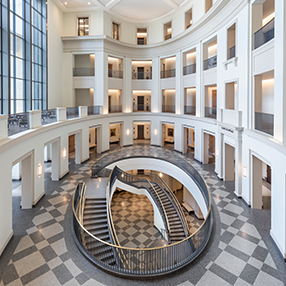
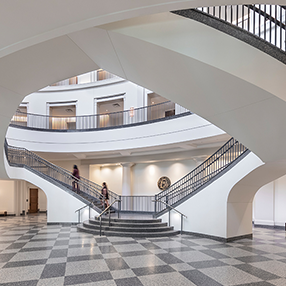
The Nathan Deal Judicial Center’s central atrium, for example, not only organizes movement and provides visual connections to key civic landmarks but also floods the interior with natural light and offers expansive views to the exterior, a naturally calming effect for visitors and staff alike. Most notably, the atrium’s large window frames a direct view of the state capitol building, visually linking the judicial branch to Capitol Hill and the executive and legislative branches of state government, reinforcing both dignity and transparency.
For courthouses with heavier operational load, this intuitive approach sustainably supports a calmer, more secure environment while significantly easing the burden on facility staff and enhancing the visitor experience.
2 | Use an Atrium, Courtyard, or Equivalent Organizing Element as the Civic Heart
A courthouse must welcome the public and enforce strict separation of functions. One of the most effective ways to do both is to provide a strong orienting element that makes the building immediately readable.
Design move: Create a primary internal landmark. A strong internal landmark—like an atrium or courtyard—anchors visitor orientation, clarifies paths to key destinations, and brings daylight deep into the building. This approach supports both security and a positive public experience, regardless of whether the facility serves appellate courts or a broader range of judicial functions.
This may look like:
- Anchoring visitor orientation from the moment of entry.
- Clarifying path to key destinations, like courtrooms, clerk services, jury selection and security screening, while incorporating character and subtle references to the building’s history or local culture.
- Bringing daylight deep into the building to reduce institutional coldness.
The Nathan Deal Judicial Center’s 112-foot central atrium is a good example of architecture doing quiet work: it supports circulation logic while reinforcing dignity and transparency.
 3 | Design the Separation as Carefully as the Spaces
Security in courthouses is not optional, but it doesn’t have to feel hostile. And security needs vary widely from one facility to another. The most successful projects integrate secure planning early, ensuring clean, enforceable separation between public, private, and secure circulation.
Design move: Plan for clean, enforceable separation. Effective courthouse design incorporates security early, ensuring it’s seamlessly integrated—not added on later.
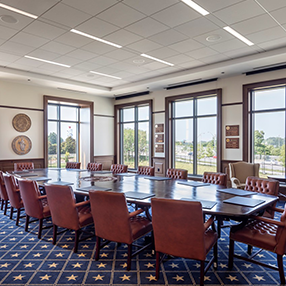
While the Nathan Deal Judicial Center’s needs were specific to appellate courts, with no jurors or in-custody defendants, the principle applies across all our judicial project types: resolving circulation flows up front supports both openness and uncompromising security.
4 | Treat Stewardship like a Design Requirement (Because It Is)
Judicial facilities are long-life public investments. Building performance, operating costs, maintainability, and durability matter as much as first impressions, especially when projects are funded under intense public scrutiny.
The Nathan Deal Judicial Center project’s efficient systems and durable materials set a benchmark, but every courthouse can benefit from strategies like energy-saving systems, water conservation, and adaptive reuse of assets.
Design move: Build performance and resource responsibility into the design narrative.
This may look like:
- Extremely efficient building envelope.
- Energy-efficient systems (e.g., hybrid mechanical systems, LED lighting).
- Water-saving strategies.
- Durable, maintainable material choices.
- Salvaged and repurposed materials and equipment where possible.
The Nathan Deal Judicial Center project achieved a three-Peach rating under the Georgia Peach Green Building Rating System, incorporating water-saving systems, Georgia-sourced materials, and efficiency-forward building systems.
5 | Prove You Can Deliver: Continuity Beats Charisma
Courthouse projects span years, administrations, stakeholder changes, and evolving operational requirements. The hidden success factor is often not a single design idea—it’s disciplined delivery and sustained coordination. Judicial buildings succeed or fail as much on execution as on design.
Design move: Establish a governance and delivery approach surviving change.
This may look like:
- Transparent communication and decision tracking
- Consistent documentation through long timelines
- Disciplined coordination across agencies and oversight bodies
- A team structure that supports continuity from planning through occupancy
The Nathan Deal Judicial Center was guided across more than a decade of development, including Capitol Hill site studies, historic preservation requirements, and full demolition, while staying predictable in schedule and budget.
On the Record: Read SSOE’s Nathan Deal Judicial Center Project Profile
 Why Do These Five Matter (Especially Pre-RFP)?
For judicial leaders and facilities stakeholders, these moves map to outcomes that are easy to defend internally and publicly:
- Better safety through clear circulation logic.
- Lower operating costs over the life of the building.
- A simplified, respectful public experience and operational effort.
- Fewer surprises during delivery.
In Closing Arguments
A courthouse isn’t simply a building type; it’s a public contract. Whether serving a state’s highest courts or a local community, the facility expresses stability, equity, and public accountability through its design. When a building’s past, community context, and client vision are thoughtfully aligned, the result is a design narrative that feels cohesive, purposeful, and enduring.
Built on Precedent: Explore SSOE’s Government / Judicial Portfolio