

For many people, a courthouse visit is unfamiliar, emotional, and consequential. While architecture establishes civic presence, it’s the interior environment—how spaces are sequenced, how secure areas are integrated, how people orient themselves—that ultimately shapes whether the experience feels clear, respectful, and fair.
On judicial projects, success depends on aligning architectural intent with the realities of courtroom operations, security protocols, and daily public use. When those disciplines are fully integrated early on, design decisions can reinforce dignity without intimidation, and efficiency without coldness.
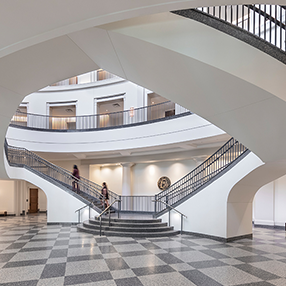
At Georgia’s Nathan Deal Judicial Center, our design team, with partner RAMSA focused on interior clarity as a civic responsibility. A light-filled central atrium organizes circulation and reduces uncertainty for visitors, while courtroom and chamber interiors balance gravitas with human scale. Materials, daylight, acoustics, and furnishings were all considered part of the justice experience, not decorative afterthoughts.
 Judicial interiors must perform under pressure, balancing security, access, and privacy while adapting to evolving court procedures and supporting the people who work in these spaces every day. Achieving that balance requires sustained collaboration over time, especially on projects that span years of planning and changing stakeholder needs.
Every jurisdiction is different, but the principle holds: when interior planning and architectural vision move in step, courthouses can communicate transparency, order, and calm—before a word is spoken or a case is heard. For public institutions, that quiet confidence is one of design’s most important outcomes.