
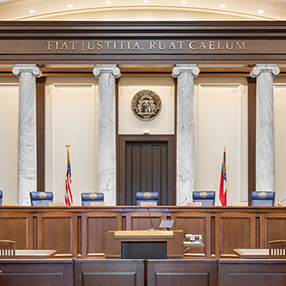
Courthouses carry unique responsibility. They must function as highly secure, complex workplaces while also welcoming the public into a process that depends on trust. Long before anyone enters a courtroom, the building is already communicating—through clarity, dignity, and how it choreographs first-time visitors alongside daily operations.
On Georgia’s Nathan Deal Judicial Center, created as the state’s first building devoted entirely to the judiciary, our design team and partner RAMSA aligned early around a simple idea: make the public experience intuitive without compromising the rigor of judicial operations. That meant designing easy-to-navigate spaces, balancing openness with appropriate security, and giving the institution a civic presence that feels steady rather than showy.
 At the heart of the building is a central atrium that organizes movement and orientation—using daylight, sightlines, and a legible hierarchy of spaces to reduce uncertainty for visitors. On the exterior, the architecture draws from a restrained classical language long associated with American justice, establishing a visual conversation with Georgia’s State Capitol across a complicated urban condition.
 What made the effort durable was not a single design gesture, but sustained collaboration: programming, site considerations, inclusive stakeholder engagement, and coordination across many disciplines over a long horizon. In complex civic projects, continuity matters—because leadership, needs, and constraints inevitably evolve, and the work must remain coherent from early planning through construction and occupancy.
Every jurisdiction is different, but the principles travel well. A courthouse should be easy to understand, respectful in tone, and resource-responsible in how it’s built and operated. When design and delivery teams share a common civic intent, the building can do more than house the courts. It can help the public feel the system inside is orderly, accessible, and worthy of their confidence.
Built on Precedent: Explore SSOE’s Government / Judicial Portfolio